The Truth About the Curriculum: Broad Skills That Matter More Than Topics
Apr 21, 2026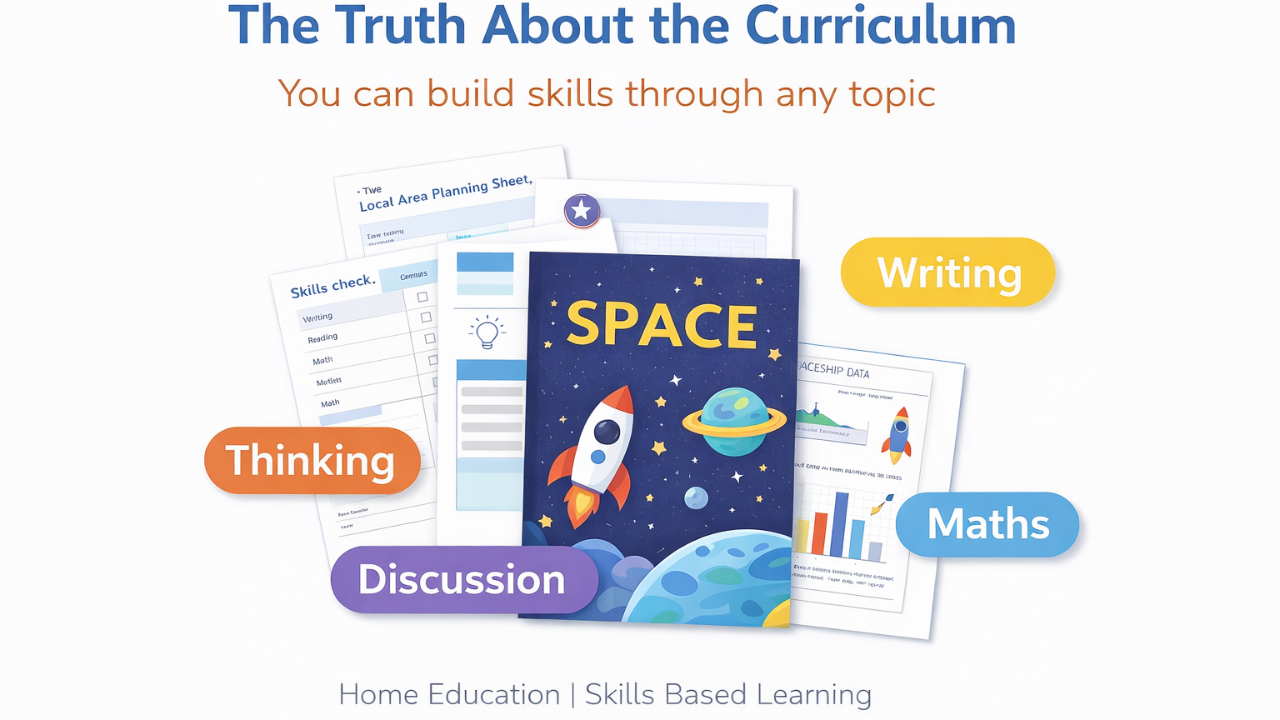
The Truth About the Curriculum: Broad Skills That Matter More Than Topics
I work with many parents who feel that they need to follow the curriculum, even though this is only a guideline, even within schools. They often want to cover everything and feel that sticking closely to the curriculum will make sure there are no gaps in their child’s learning.
In this blog, we are going to look at how you can approach this differently, so you can use the curriculum as a guide while focusing on the skills just as much as the content.
Understanding the Curriculum
The curriculum is broken down into different subject areas. It was originally set up to help schools follow a shared structure, so there was consistency across teaching in the United Kingdom. Within that, there are many skills, and these can be taught in different ways and in different orders. Schools and curriculum writers have organised this in a way that works for the classroom, which is why some topics appear earlier or later.
This is why it is important to see the curriculum as a guide to skills. If you feel your child is ready to explore something, you can move to that area. It does have value, as it helps you keep an overview of what is being covered, but it is important that you use it in a way that works for your child.
Skills and Knowledge: What Is the Difference?
Knowledge is something you know. It is a fact, such as a times table, a historical date, or a piece of information you can recall at a point in time.
A skill is how you learn, use and apply that knowledge. It is something that develops over time and can be used across different topics.
For example, in English, the knowledge might be understanding what a report or a story is. The skill is being able to write for a purpose, organise ideas, and adapt your writing for a different audience.
In maths, the knowledge might be understanding what a graph is. The skill is being able to collect data, choose how to present it, interpret it, and explain what it shows.
In history or geography, the knowledge might be facts about a place or time. The skill is being able to compare, explain cause and effect, or present information clearly.
These skills do not belong to one topic. They can be revisited again and again.
How Skills Develop Through Everyday Learning
Parents we work with are often surprised at how much learning comes from small, not always obvious activities, and how these link across different subjects.
Many people make the connection between cooking and skills such as measuring or reading the time. However, there is often much more happening within one activity.
I have worked with a child who loved fishing, and this became the focus of their topic work. They wrote a guide for younger children, created a poster of common fish found in their local river, and calculated the cost of the equipment they needed.
In another case, a topic on horses led to route planning for a local hack, understanding the local geography, and exploring the history of horses in depth. They created a wall timeline with notes and information, alongside collecting images and drawings.
In both cases, the topic stayed the same, but the skills being developed were wide ranging. These included writing for a purpose, presenting information, using maths in a real context, understanding geography, and making connections across time.
This is where home education gives you flexibility. You can take a topic your child is interested in and build the learning around those skills. Instead of feeling that you need to move on because the topic has finished, you can stay with it and go deeper.
You might return to writing in different forms, revisit data in different ways, or come back to discussion and explanation as your child grows in confidence. What matters is that the skill is being practised and developed over time.
Although many families refer to the UK curriculum, and some countries do not follow a set curriculum at all, skills are transferable and topics are global. This means you can take one topic and use it to practise a wide range of skills, wherever you are based. You can loosely link to a curriculum if you choose, but the learning itself is not limited by it.
Many of our themed learning packs are designed with this in mind. They focus on building and revisiting key skills through one topic, while giving you the flexibility to adapt the learning in a way that suits your child. The planning, activities and ideas are there to give you a clear starting point, without needing to spend hours researching or wondering what to do next.
How to Recognise Progress Without Tests
A common concern is how to recognise progress without following the curriculum closely or using formal tests.
Progress can be seen in many ways. Your child may begin to ask different questions or challenge ideas more. They may be able to explain something more clearly, or complete a task that previously felt difficult. You might notice that they are becoming more confident and independent in how they approach their learning.
They may move from simple tasks to more complex ones. They may begin to make connections between ideas, use different methods, or make choices about how they present their work. You may also notice changes in the clarity of their writing, the accuracy and speed in maths, or their willingness to discuss and explore ideas.
Often, you will see it in their confidence and enjoyment as much as anything else.
Using the Curriculum in a Way That Works for You
If you are using the curriculum as a guide, that is absolutely fine. It can help you see the range of skills and ideas your child may come across over time.
It is also important to remember that it is not something you need to follow step by step.
You can use it to support your thinking, while still following your child’s interests and building skills in a way that works for your family.
When you focus on the skills, rather than trying to move through topics, you often find that learning becomes deeper, more connected, and more enjoyable.
If you would like to explore this approach further, you can take a look here:
Explore our themed learning packs
Try Our Resources
Join our mailing list to receive and not only will you the latest news and updates from our team.
You can also download our mini-pack on 1000 hours outdoors.